Prices checked 24 November 2026
The best online German courses, checked against their own pages
We read 60+ pages from 21 online German courses, saved every price with the date we saw it, and pulled 14 Trustpilot profiles and 105 learner threads. Here is what is worth paying for.
The short answer
- Best for actually speakingLALIA BerlinA fixed group of at most 9, four 50-minute live classes a week, built around talking from the first session.
- Best for a flexible scheduleLingodaLive classes of 3 to 5 students you book one at a time, around the clock, with a 7-day free trial.
- Best if you need the certificateGoethe-Institut OnlineThe institution behind the Goethe-Zertifikat, teaching to its own exam in 10-week live terms.
- Lowest price per live hourDeutschAkademie Online48 live hours in four weeks for about €6.40 an hour, every level from A1 to C2, new starts every month.
- Best appBabbelThe most structured self-paced course of the apps we checked, with clear grammar and one subscription for 14 languages.
- Best free courseDW Learn German (Nicos Weg)Deutsche Welle's video course takes you from zero to B1 with exercises and grammar pages, and nothing is behind a paywall.
All 11 courses side by side
4 live schools first, then apps and self-paced courses. Prices exactly as each provider publishes them, in their currency. Tap a name to jump to its review.
| Course | Format | Price | Group | Levels | Free trial | Rating |
|---|---|---|---|---|---|---|
| LALIA Berlin | Live classes | from €239/month | max 9 | Beginner to C1 | No | 4.9 · 140 on Google |
| Lingoda | Live classes | $99.99 to $539.99 per 4 weeks | 3-5 | A1 to C1 | 7 days free: 3 group classes or 1 private class | 4.2 · 5,943 |
| Goethe-Institut Online | Live classes | $735 per 10-week sub-level (US) | not published on the US page | A1 to C2 | Free trial chapters of the learning platform | 1.8 · 48 |
| DeutschAkademie Online | Live classes | from €309 per 4-week intensive | 10-12 on average, max 14 | A1 to C2 | No | 2.1 · 11 |
| Babbel | App | $17.99/month, $107.99/year (US App Store) | — | Beginner to advanced | Free first lesson | 4.4 · 33,491 |
| Busuu | App | Free tier; Premium priced by country | — | A1 to B2 | Free tier with ads and limited features | 4.2 · 20,040 |
| Rocket German | Self-paced course | $149.95 one-time (Level 1) | — | 3 levels | Free trial | 3.1 · 11 |
| Pimsleur German | Audio course | $19.99/month (US App Store, one language) | — | 5 levels | 7-day free trial | 4.3 · 254 |
| SmarterGerman | Self-paced course | €29.90/month or €299/year | — | A1 to C1 | 7-day free trial | none |
| lingoni German | Self-paced course | €9/month or €89/year | — | A1 to B2 | 7-day free trial on monthly plans | 4.7 · 258 |
| DW Learn German (Nicos Weg) | Free course | Free | — | A1 to B1 (free DW material to C1) | No | n/a |
How we checked
- 21 online German courses looked at, 11 kept. Tutor marketplaces and in-person schools left out on purpose.
- 60+ provider pages saved with the date we read them, and 94 screenshots. Every price on this page comes from the provider's own pricing page, never from another review site.
- 14 Trustpilot profiles read in full, including whether the company pays Trustpilot and invites reviews.
- 105 learner threads on Reddit found and sorted by course.
- 2 well-known options turned out to be closed: Chatterbug and Babbel Live.
What one hour of live teaching costs
The cheapest hour is also the biggest room. DeutschAkademie's groups average 10 to 12 people, so each learner speaks for a few minutes per hour. Lingoda caps groups at 5 and LALIA at 9. Divide the hourly price by the group size you can live with, not by the sticker.
At the Goethe-Institut USA, every CEFR level is split into separate 10-week terms (A1.1, A1.2, A1.3 and so on). Going from zero to B1 is 10 terms. At $735 each, that is $7,350 before the exam fee.
What Trustpilot says, read properly
Babbel, Busuu and Lingoda pay for Trustpilot and ask customers for reviews, which lifts their scores. The Goethe-Institut does not, and its recent one-star reviews name the online course itself: dated materials, little flexibility, a high price. LALIA Berlin has no Trustpilot profile; its reviews are on Google, where it shows 4.9 from 140.
The reviews
Each review starts from the provider’s own pages, read and saved on 24 November 2026. Prices are quoted the way the provider publishes them. Where a learner community or Trustpilot tells a different story from the sales page, we say so.
1 LALIA Berlin
Live speaking classes in a fixed small group. From €239 a month.
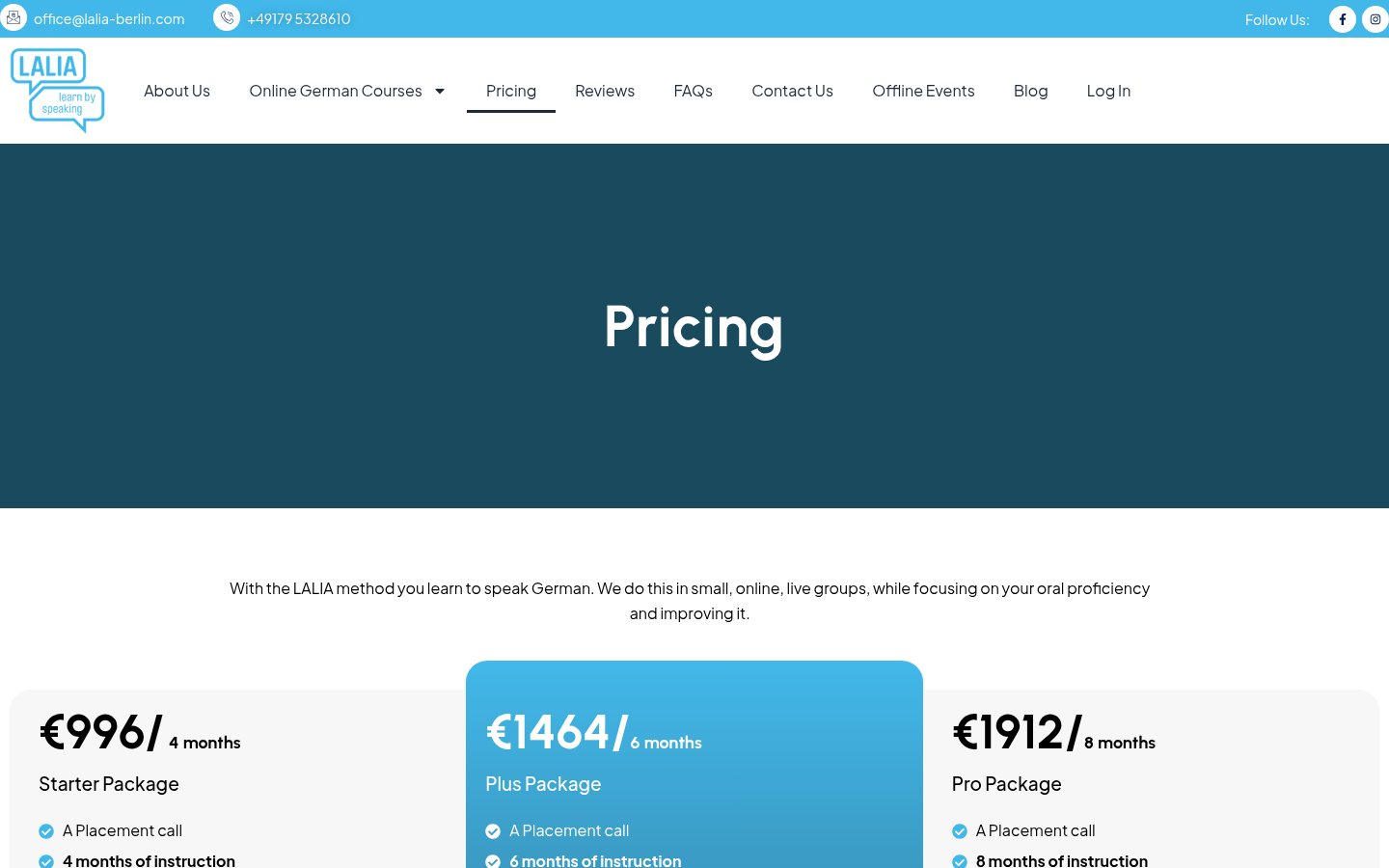
LALIA is an online school run by two teachers who taught German at Stanford with the communicative method: you learn by talking, and grammar is taught when you need it to say something. Groups are capped at 9. Beginners meet four times a week for 50 minutes, advanced groups three times for 70 minutes, in morning or evening slots on Berlin time. A new course starts at every level every five weeks.
| Package | Price | Per month |
|---|---|---|
| 4 months | €996 | €249 |
| 6 months | €1,464 | €244 |
| 8 months | €1,912 | €239 |
Paying in three instalments adds a one-off €87 fee. There is no trial class; instead you book a free 15-minute placement call, and the minimum is 16 weeks of teaching.
Good for: people who have tried apps or grammar-first classes and still freeze when they have to speak. Skip it if: you want explicit grammar explanations, a certificate, or a month-to-month plan.
What we found. LALIA shows 4.9 stars from 140 Google reviews and has no Trustpilot profile. On Reddit the praise is about real speaking progress ("4 one hour classes a week, love it and have made real progress"), and the one sharp criticism is about structure: it is not the place if you want grammar taught explicitly. That matches LALIA's own FAQ, which says grammar is not its main focus. At about €18.70 per live hour it sits mid-table on price, with the smallest fixed group of the four live schools.
2 Lingoda
Live classes you book one at a time, any hour. $99.99 to $539.99 per 4 weeks.
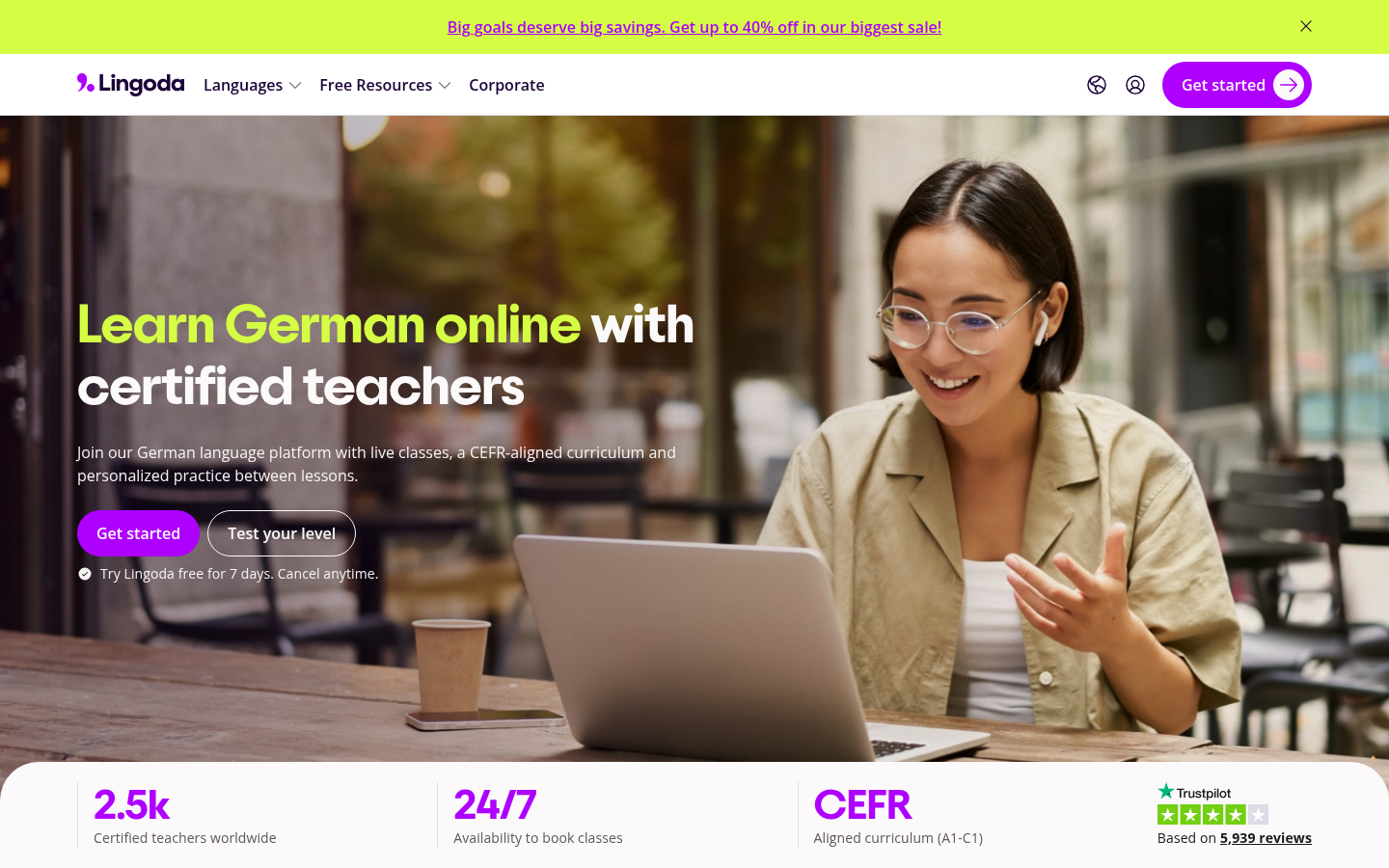
Lingoda sells 60-minute live classes of 3 to 5 students on a rolling 4-week plan. You pick a class from the timetable, so the teacher and the classmates change from class to class. The curriculum follows the CEFR from A1 to C1.
| Plan (German, group) | Per 4 weeks | Per class |
|---|---|---|
| 5 classes | $99.99 | $20.00 |
| 12 classes | $199.99 | $16.67 |
| 20 classes | $299.99 | $15.00 |
| 40 classes | $539.99 | $13.50 |
The 7-day free trial covers 3 group classes or 1 private class. There is a 14-day money-back guarantee, minus classes taken, and you can pause for up to 4 weeks once per billing cycle.
Good for: shift workers, parents, anyone whose week does not repeat. Skip it if: you want the same teacher and the same group every week.
What we found. On the same pricing page, German costs more than English (5 classes: €79.99 for German, €74.99 for English). The Black Friday discount runs to 40% but applies to the first month only and to new students only. On Trustpilot Lingoda scores 4.2 from 5,943 reviews; it pays Trustpilot and invites reviews. The four-star reviews keep repeating one caveat: most teachers are good, a few are not, and you cannot always choose.
3 Goethe-Institut Online
Live 10-week terms from the people who run the exam. $735 per term in the US.
The Goethe-Institut USA runs live online group courses of 10 weeks: standard terms meet twice a week for 90 minutes, relaxed terms once a week, and the super-intensive A1 or A2 three times a week with self-study on its platform. Prices differ by country, since each institute sets its own.
| Course (Goethe-Institut USA) | Length | Price |
|---|---|---|
| German Online Live, one sub-level | 10 weeks, 2 x 90 min a week | $735 |
| Relaxed German Online Live, half a sub-level | 10 weeks, 1 x 90 min a week | $379 |
| Super-Intensive with Self-Study, A1 or A2 | 10 weeks, 3 x 90 min a week | $1,969 |
| Placement test | $25, refunded if you book |
Good for: anyone who needs a Goethe-Zertifikat for a visa, a job or university, and wants lessons aimed at that exam. Skip it if: you want flexibility or value per hour.
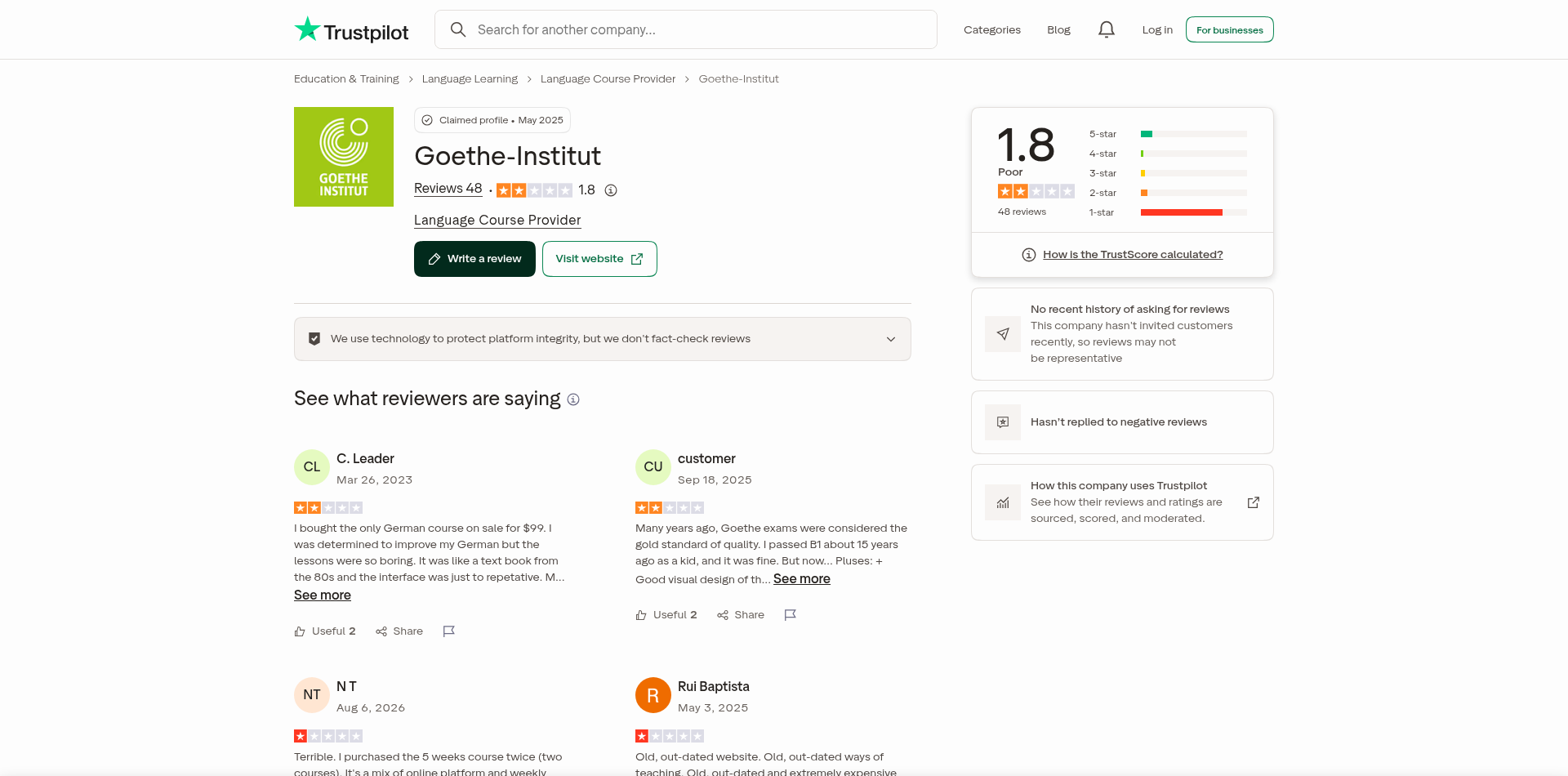
What we found. Each CEFR level is split into 3 or 4 sub-levels, and each sub-level is its own $735 term. From zero to B1 that is 10 terms and $7,350, before the exam fee. Learners on Reddit call the sub-level system a cash cow. On Trustpilot the institute scores 1.8 from 48 reviews and does not invite reviews, and the recent one-star reviews name the online course itself: dated materials and little flexibility. Prices vary a lot by country: learners report far cheaper online terms from Goethe institutes in India.
4 DeutschAkademie Online
Live intensive courses, the lowest price per hour. From €309 for 4 weeks.
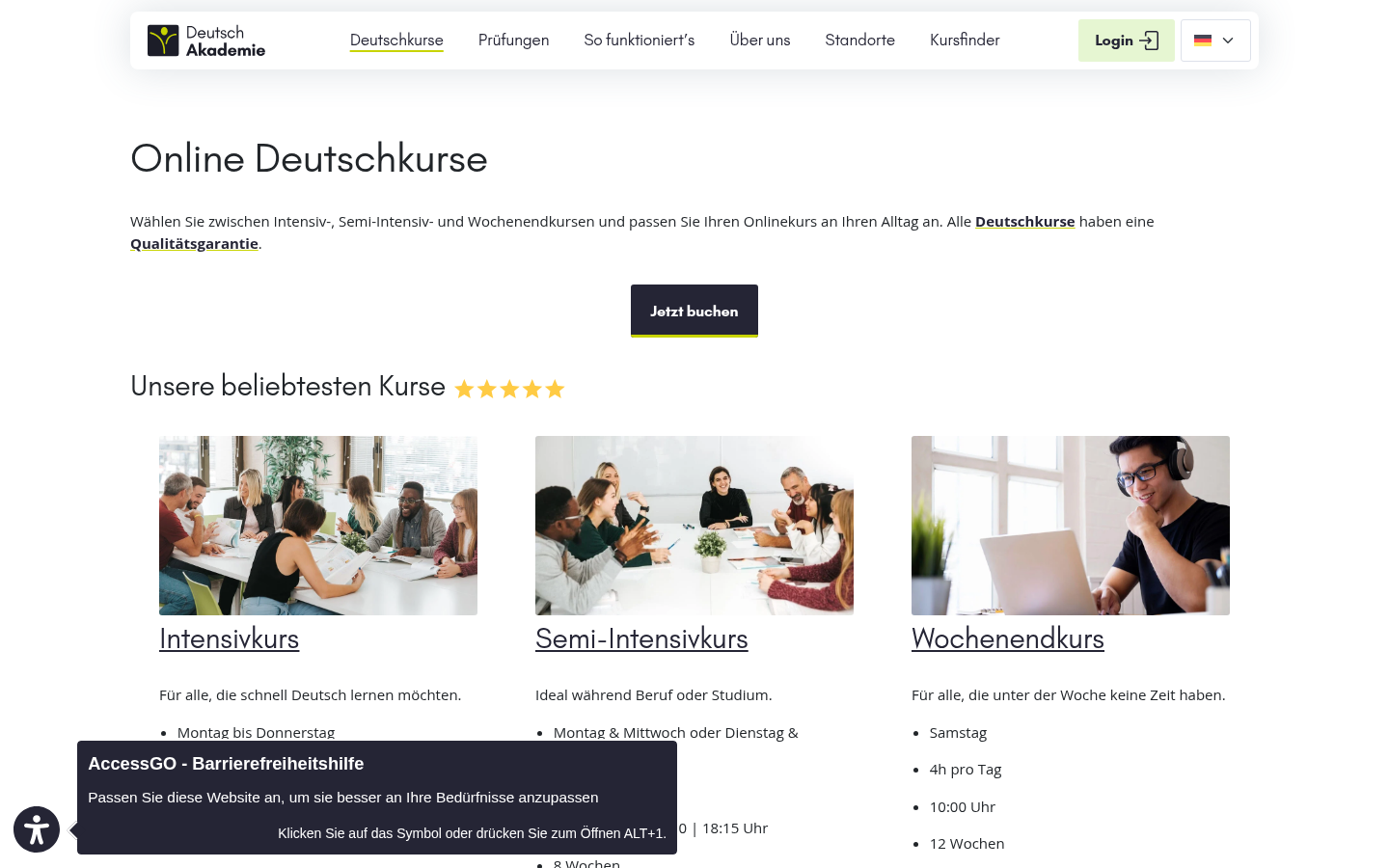
DeutschAkademie, a school with branches across Germany and Austria, runs live online groups for every level from A1 to C2. The intensive course is 4 weeks, Monday to Thursday, 3 hours a day: 48 hours that cover half a level. The semi-intensive spreads the same content over 8 weeks at two days a week, and a weekend course runs for 12 weeks. Groups average 10 to 12 people, with a maximum of 14, and new courses start every month in four daily time slots on Central European Time.
| Course | Schedule | Price |
|---|---|---|
| Intensive online | 4 weeks, Mon to Thu, 3 h a day | from €309 |
| Semi-intensive online | 8 weeks, 2 days a week | from €309 |
| Weekend online | 12 weeks | €339 |
Good for: people who can give German three hours a day and want the most teaching per euro, or who are preparing for telc and ÖSD exams. Skip it if: you live outside European time zones or want a small group.
What we found. At about €6.40 per live hour it is the cheapest live option by a wide margin, but with up to 14 people in the room you speak far less of that hour. Reddit learners describe good teachers and a demanding pace ("like running a race"). Its Trustpilot profile has only 11 reviews, mostly about refunds after a cancelled course, which is too small a sample to judge the school on.
5 Babbel
A structured app course with clear grammar. $107.99 a year.
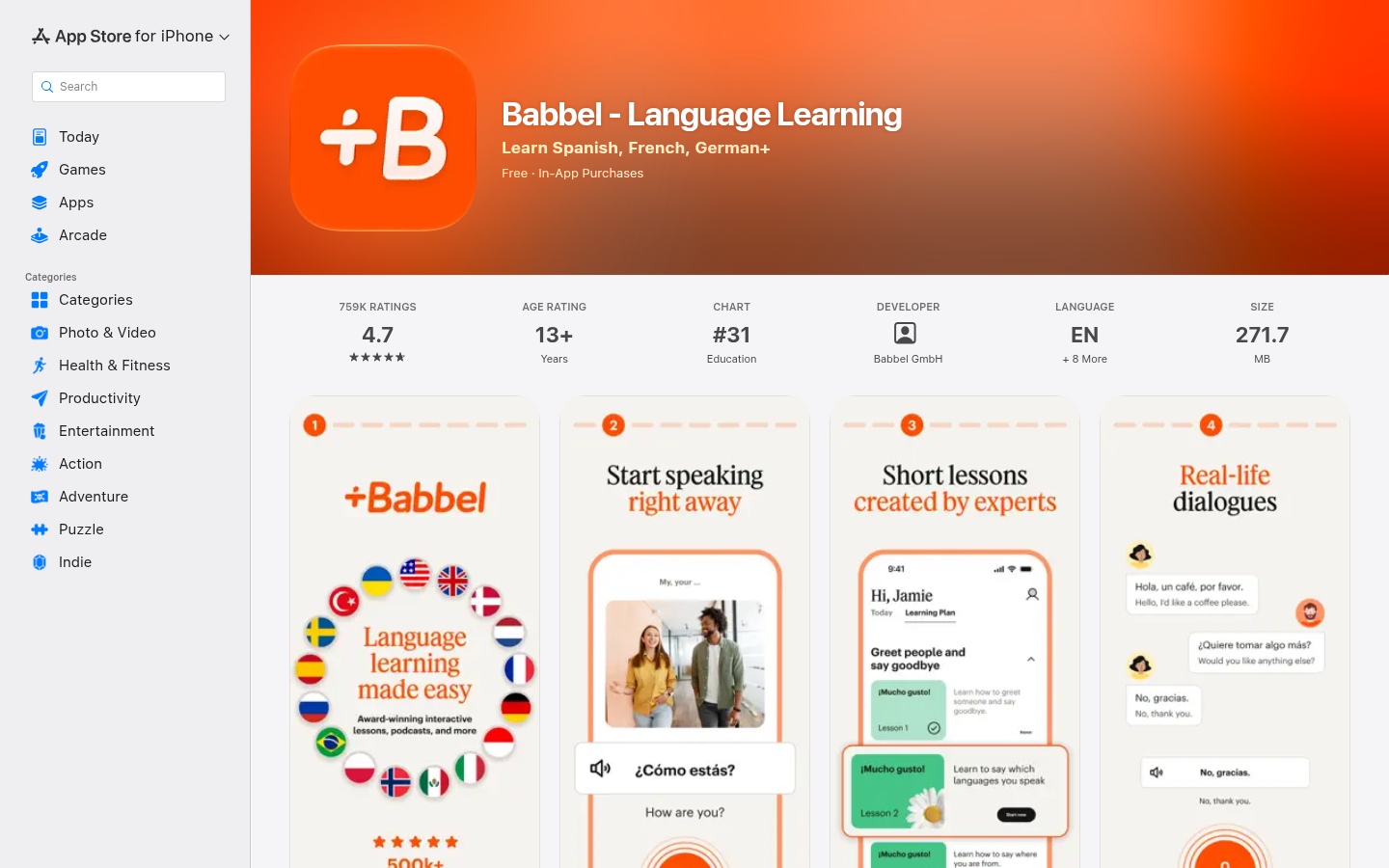
Babbel is a self-paced app: short lessons, review exercises, grammar explained in English and AI speaking practice. One subscription covers all 14 of its languages. It ended its live classes, Babbel Live, on 1 July 2025, so for individual learners Babbel is now an app only.
| Plan (US App Store) | Price |
|---|---|
| 1 month | $17.99 |
| 3 months | $45.99 |
| 12 months, all languages | $107.99 |
On Babbel’s own site, priced in euros: €8.99 a month on the yearly plan and €299.99 for lifetime access.
Good for: steady daily practice and a clear grammar path, alone. Skip it if: you need to talk to a person.
What we found. 4.7 from 759,000 ratings on the US App Store and 4.4 from 33,491 reviews on Trustpilot, where Babbel pays for the service and many recent reviews are invited. If a comparison you are reading recommends Babbel's live classes, it was written before July 2025.
6 Busuu
An app with corrections from native speakers. Free tier; Premium priced by country.
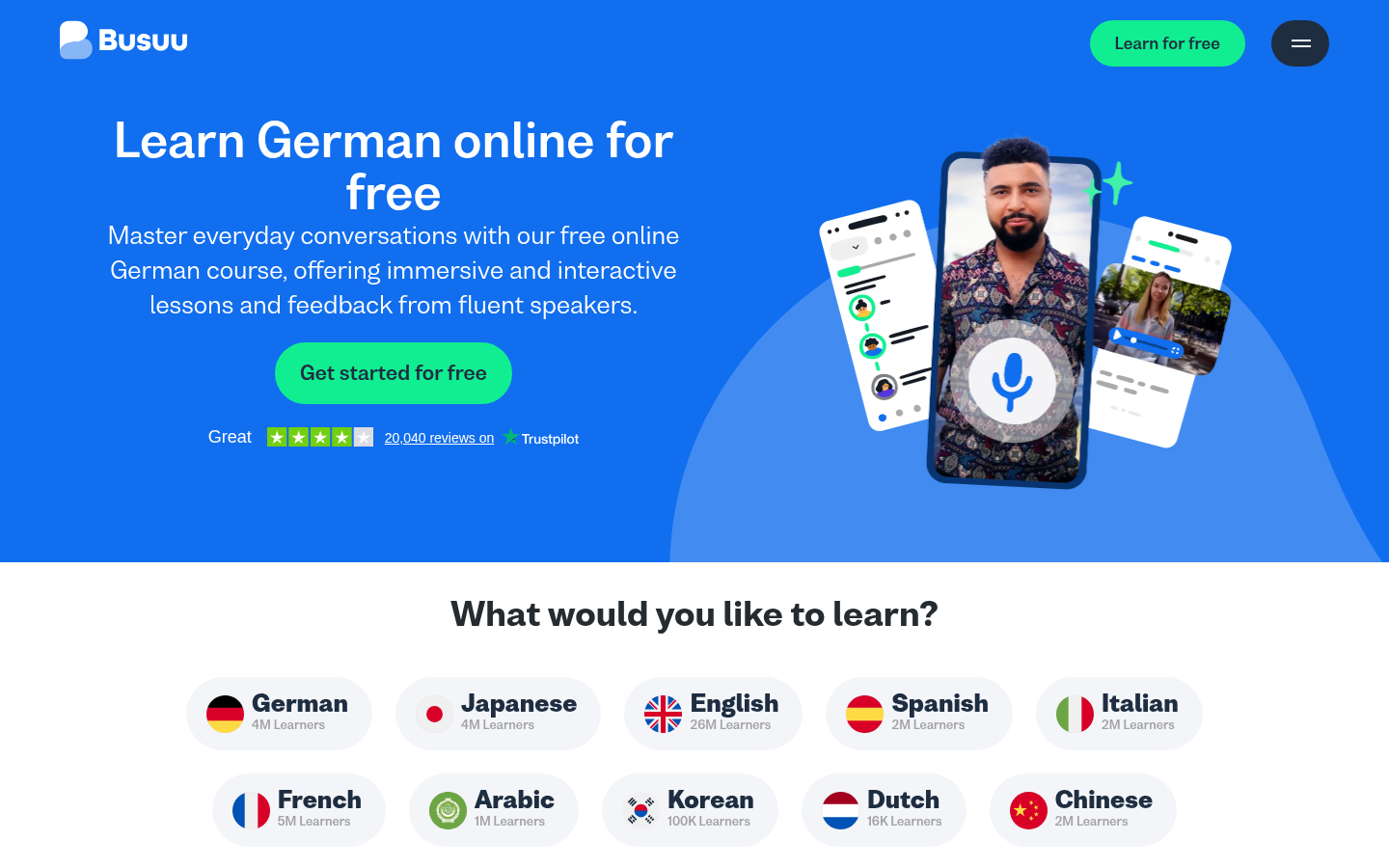
Busuu’s Complete German runs from A1 to B2 in short app lessons. Its distinctive feature is community feedback: you record or write an answer and native speakers correct it. Premium adds grammar and vocabulary review, speaking assessments and Busuu’s own certificates; Premium Plus adds AI conversation and pronunciation practice.
Good for: a free start, and feedback on your writing without paying a teacher. Skip it if: you need live conversation; the native-speaker feedback is not a video call.
What we found. Busuu sets its price by where you are and its site has no currency switch: we saw it in Swedish kronor and Brazilian reais on the same day. The US App Store lists plans from $6.99 a month to $139.99 a year. App Store rating 4.7 from 102,000; Trustpilot 4.2 from 20,040, with invited reviews.
7 Rocket German
A one-time-purchase course with lifetime access. $149.95 per level.
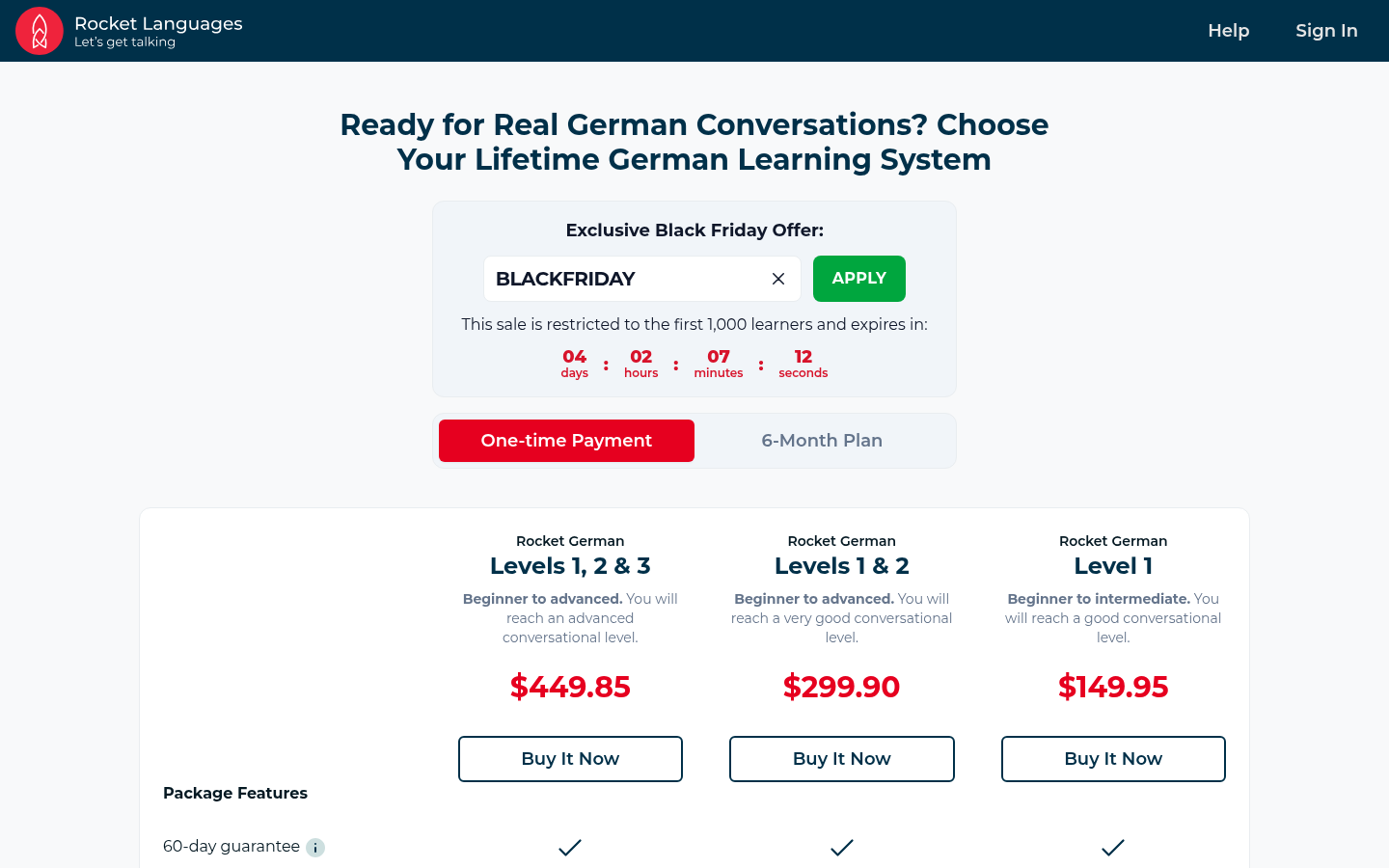
| Package | Lesson time | Price |
|---|---|---|
| Level 1 | 136 hours | $149.95 |
| Levels 1 and 2 | 266 hours | $299.90 |
| Levels 1 to 3 | 389 hours | $449.85 |
Audio lessons, language and culture lessons and voice-recognition practice, paid once and kept for life, with a 60-day money-back guarantee (bought through the iOS app, Apple’s refund rules apply instead).
Good for: people who hate subscriptions and learn well from audio. Skip it if: you want live feedback. Its Trustpilot profile has 11 reviews, too few to weigh.
8 Pimsleur
Audio-first speaking drills. $19.99 a month.
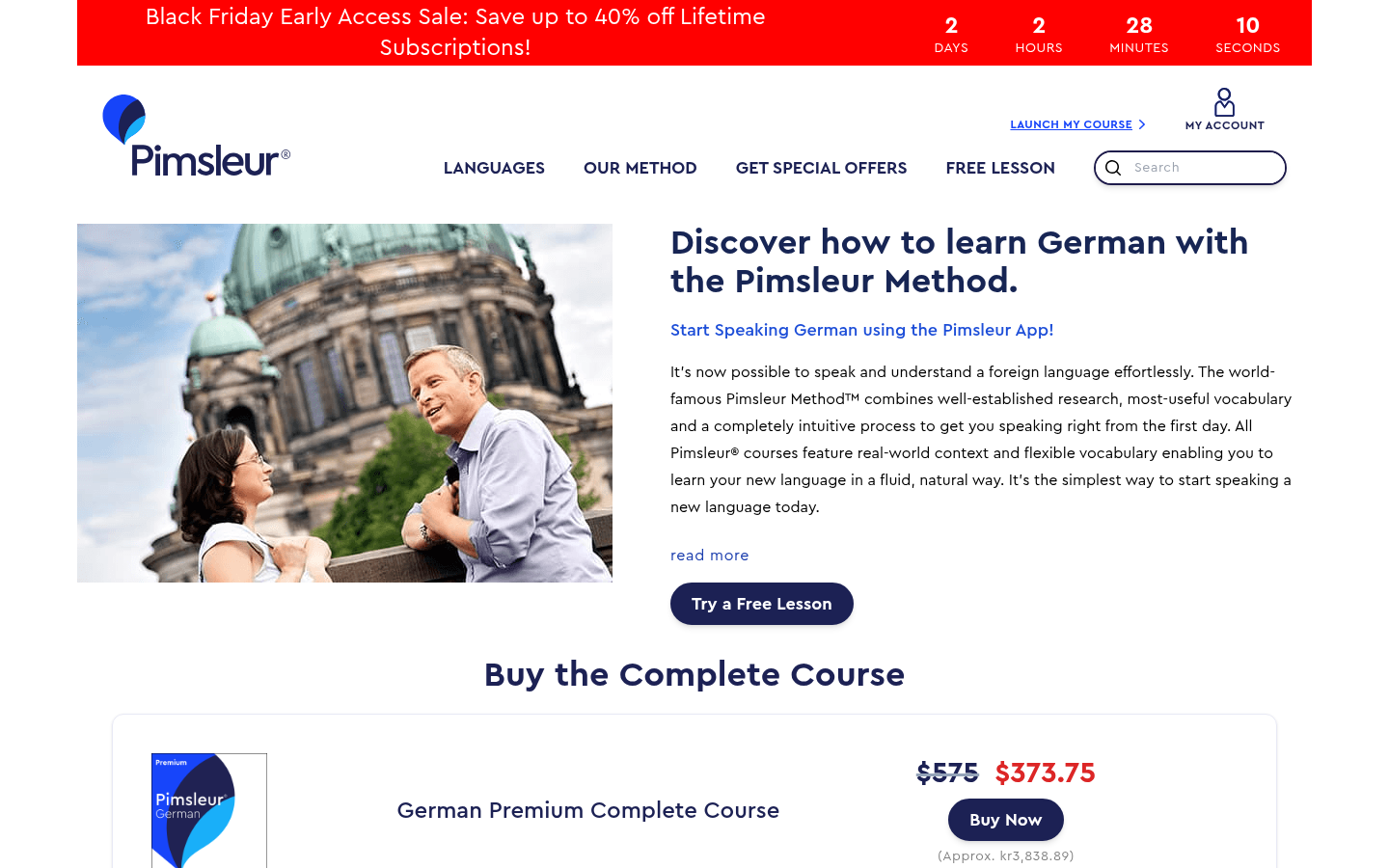
Thirty-minute audio lessons that make you answer out loud, spaced so you recall earlier material. Five levels of 30 lessons. On the US App Store a single language is $19.99 a month, and All Access is $20.99 a month or $164.99 a year. The full German course can also be bought outright for $575 (Black Friday $373.75). The trial is 7 days, and subscriptions are not refunded.
Good for: commuters, and pronunciation. Skip it if: you want reading, writing or grammar. Trustpilot 4.3 from 254, though a quarter of those are one star.
9 SmarterGerman
Self-paced video courses taught in English. €29.90 a month or €299 a year.
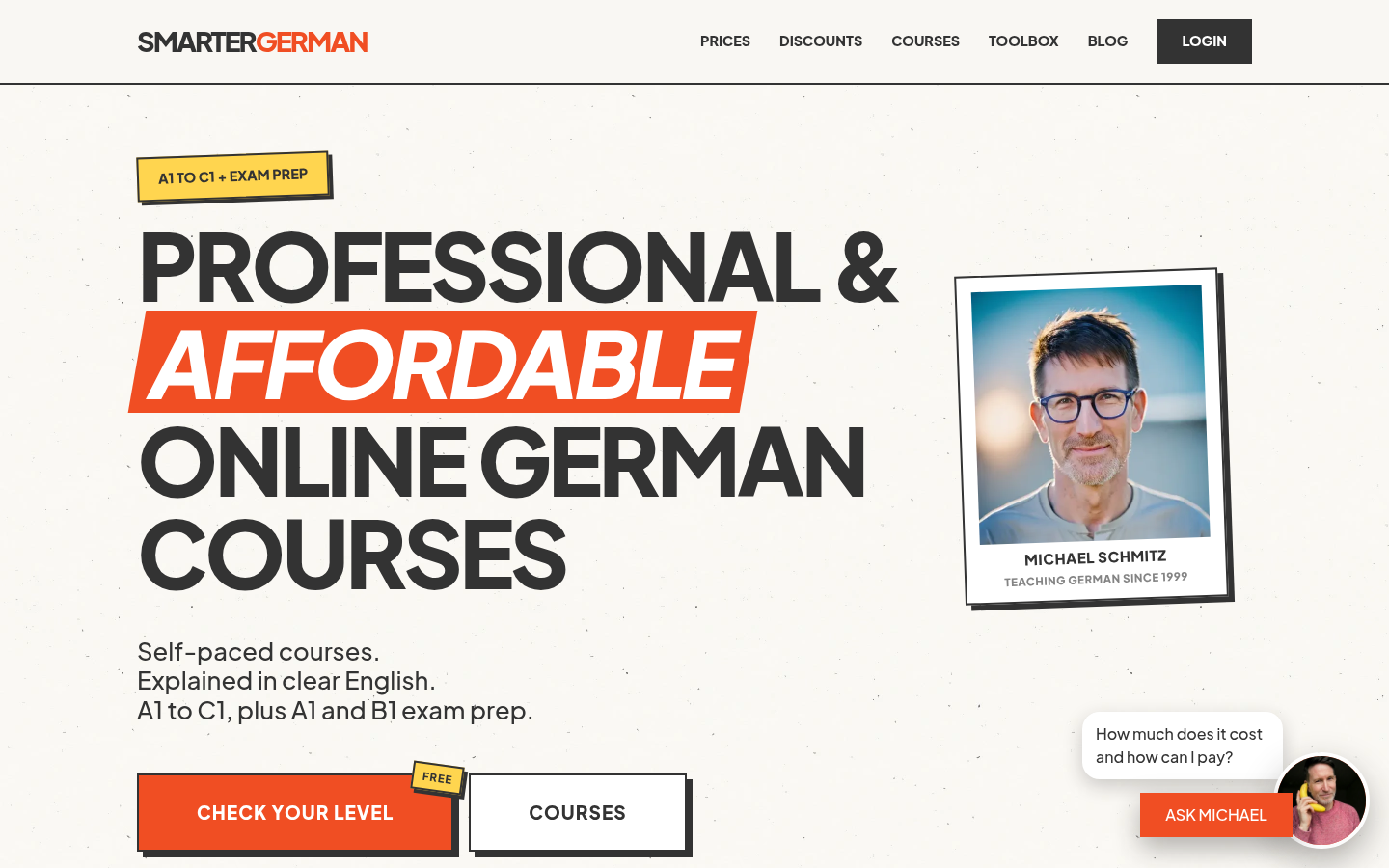
One teacher, Michael Schmitz, explaining German from A1 to C1 in English, plus A1 and B1 exam preparation. €29.90 a month, €299 for 12 months or €399 for 24 months, with a 7-day free trial and a free level assessment that covers all six skills.
Good for: self-learners who want grammar explained properly. Skip it if: you need speaking practice with people.
10 lingoni German
Video lessons, podcasts and worksheets, A1 to B2. €9 a month or €89 a year.
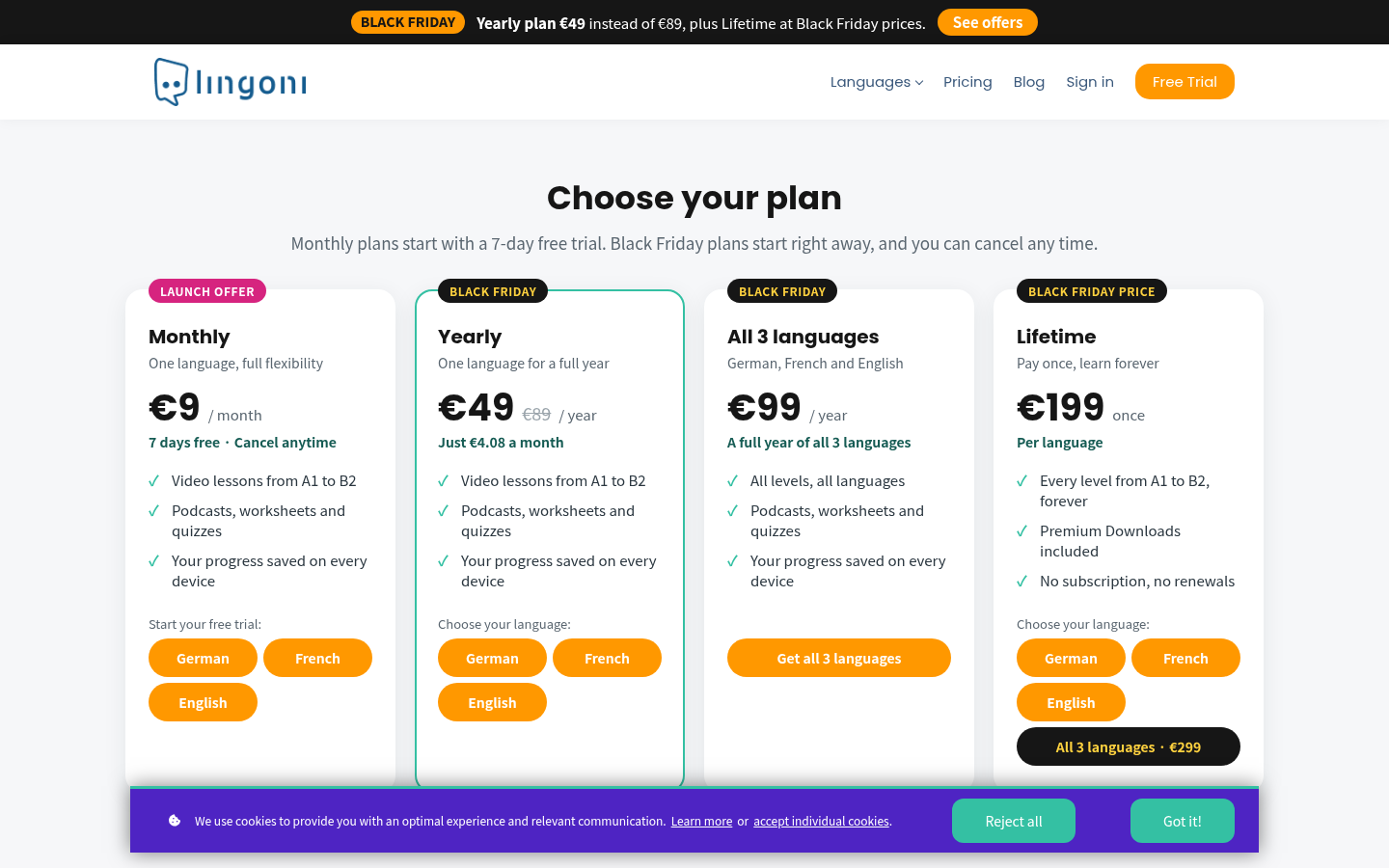
The cheapest paid course we checked: €9 a month or €89 a year (€49 in the current sale), with a 7-day free trial on monthly plans. Trustpilot 4.7 from 258 reviews, from a company that does not invite reviews, which makes it the most believable high score in this comparison.
Good for: a structured, cheap A1 to B2 path. Skip it if: you need a teacher.
11 DW Learn German: Nicos Weg
A free video course from Germany’s public broadcaster.

Nicos Weg follows a young Spaniard arriving in Germany, in short video episodes with exercises and grammar pages, from A1 to B1. Deutsche Welle adds more free material up to C1. No account and no payment are needed.
Good for: anyone starting out, and anyone checking whether they like German before paying. Skip it if: you need someone to talk to. Deutsche Welle’s Trustpilot profile reviews its news coverage, not this course, so we do not use it.
How to choose
- Decide whether you need a person. If speaking is the goal, pay for live classes. If you need structure and habit, an app or a self-paced course costs a tenth as much.
- Then decide what kind of schedule you have. A fixed weekly slot suits LALIA or the Goethe-Institut. A week that changes suits Lingoda.
- Count speaking minutes, not hours. Hourly price divided by group size is closer to what you actually buy.
- Check whether you need a certificate. Only an exam gives you one. Courses that teach toward it help; none of them replaces it.
Courses we checked and left out
- Rosetta Stone: immersion app without a German-specific path; $109.99 a year on the US App Store, and a 2.0 Trustpilot score driven by recent complaints about surprise renewals.
- GermanPod101: a large podcast library rather than a sequenced course.
- StoryLearning (German Uncovered): story-based course; $297 list.
- Berlitz: prices are quote-only.
- Seedlang: video flashcards, a good supplement but not a course.
- Deutsch-Uni Online and vhs-Lernportal: aimed at university entry and at learners living in Germany.
- Kapitel Zwei: its site refused our connection twice; we will retry.
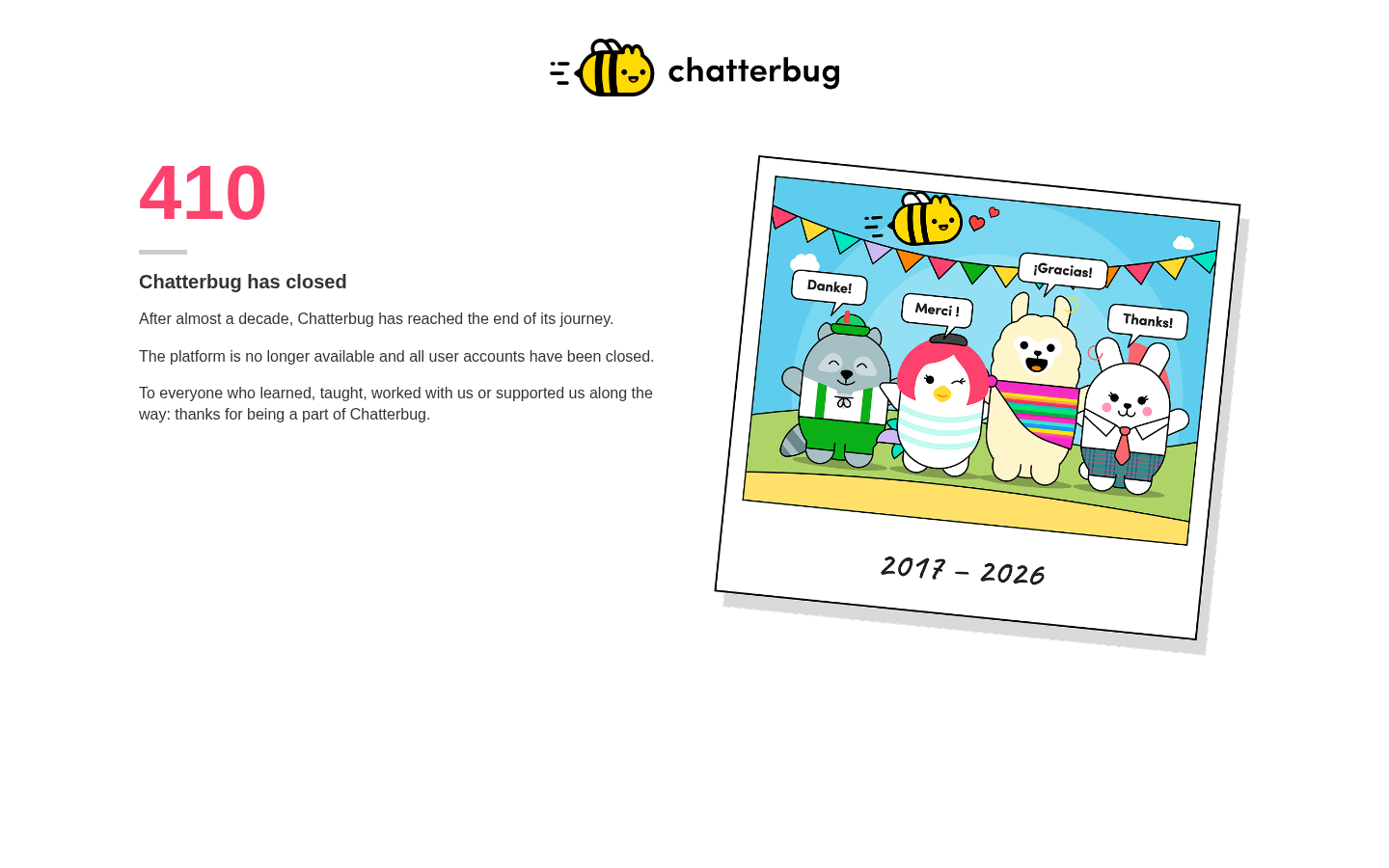
- Chatterbug: closed. Its site now shows a goodbye page covering 2017 to 2026.
- Babbel Live: closed on 1 July 2025.
Frequently asked questions
What is the best online German course?
It depends on what you need from it. For speaking in a small fixed group, LALIA Berlin (max 9 students, four 50-minute classes a week, from 239 euros a month). For a flexible schedule, Lingoda (3 to 5 students, classes bookable around the clock). For an official certificate, the Goethe-Institut. For the lowest price per live hour, DeutschAkademie (about 6.40 euros an hour, groups up to 14).
How much does an online German course cost?
Live group classes cost between about 6 euros and 25 dollars per hour of teaching at the four live schools we checked. Self-paced apps cost far less: Babbel is $107.99 a year on the US App Store, lingoni 89 euros a year, and Deutsche Welle's Nicos Weg is free.
Can you learn German online for free?
Yes, up to about B1. Deutsche Welle's Nicos Weg is a free video course from Germany's public broadcaster with exercises and grammar pages, and Busuu has a usable free tier. Free courses give you no live speaking practice, which is where paid live classes earn their price.
Which online German course gives a certificate?
None of the courses gives you an official certificate on its own. The recognized certificates come from exams (Goethe-Zertifikat, telc, ÖSD, TestDaF) that you book and pay for separately. The Goethe-Institut and DeutschAkademie prepare you for those exams; LALIA Berlin and Lingoda do not issue certificates.
Is Babbel still offering live classes?
No. Babbel ended Babbel Live, its live online classes, on 1 July 2025. Babbel is now an app-only subscription for individual learners.
We check every price on the provider's own page, save a dated copy and a screenshot, and re-check before each update. About this site →